Installation areas
Pole Pad Installation in Houston, Texas
We field our own install crews in the Houston metro, from Harris County out to Fort Bend, Montgomery, Brazoria and Galveston. That means we plan around what actually governs padding work here: a school calendar that restarts in mid-August, summer afternoons that shut down outdoor labor, and a storm season that puts every exposed pad on a removal list.
- Shipping
- All 48 contiguous states.
- Installation by our own crews
- New Jersey, New York, Connecticut, eastern Pennsylvania, plus the Austin and Houston markets in Texas. Coverage detail
Outside our installation markets we ship the product for installation by you or your contractor. Coverage states are New Jersey, New York, Connecticut, eastern Pennsylvania, the Austin and Houston metros in Texas.
Where Our Houston Crews Work and How Days Get Routed
Our install territory runs across Harris County and out into the collar counties: Fort Bend, Montgomery, Brazoria, Galveston, Waller and Chambers. Crews stage off the loops and the Grand Parkway, so a gym in Katy and a ballfield in Pearland are both ordinary jobs. What is not ordinary is putting a 7 a.m. call in Conroe and a 2 p.m. call in Alvin on the same truck, so we batch sites by corridor and quote install dates in corridor order. If you have three campuses in one district, say so at quote time and we will put them on one route.
Site access decides how long a day takes more often than the padding does. Gym work needs floor protection down before ladders roll in, someone with keys to the equipment room, and a confirmation that custodial floor refinishing is not scheduled the same week. Outdoor work needs gate codes and a clear answer on who owns the fence line, since backstop and foul-pole padding at a shared municipal field is often a parks department decision rather than a school one. Sorting that out on the phone saves a wasted trip across the metro.
- Katy, Cypress and the Grand Parkway corridor in Harris and Waller counties
- Sugar Land, Missouri City and Richmond in Fort Bend County
- The Woodlands, Spring and Conroe in Montgomery County
- Pearland, Friendswood and Alvin in Harris, Brazoria and Galveston counties
- Inside the Loop, the Heights, Bellaire and southeast Harris County
Humidity, Mildew and Storm Season on Gulf Coast Padding
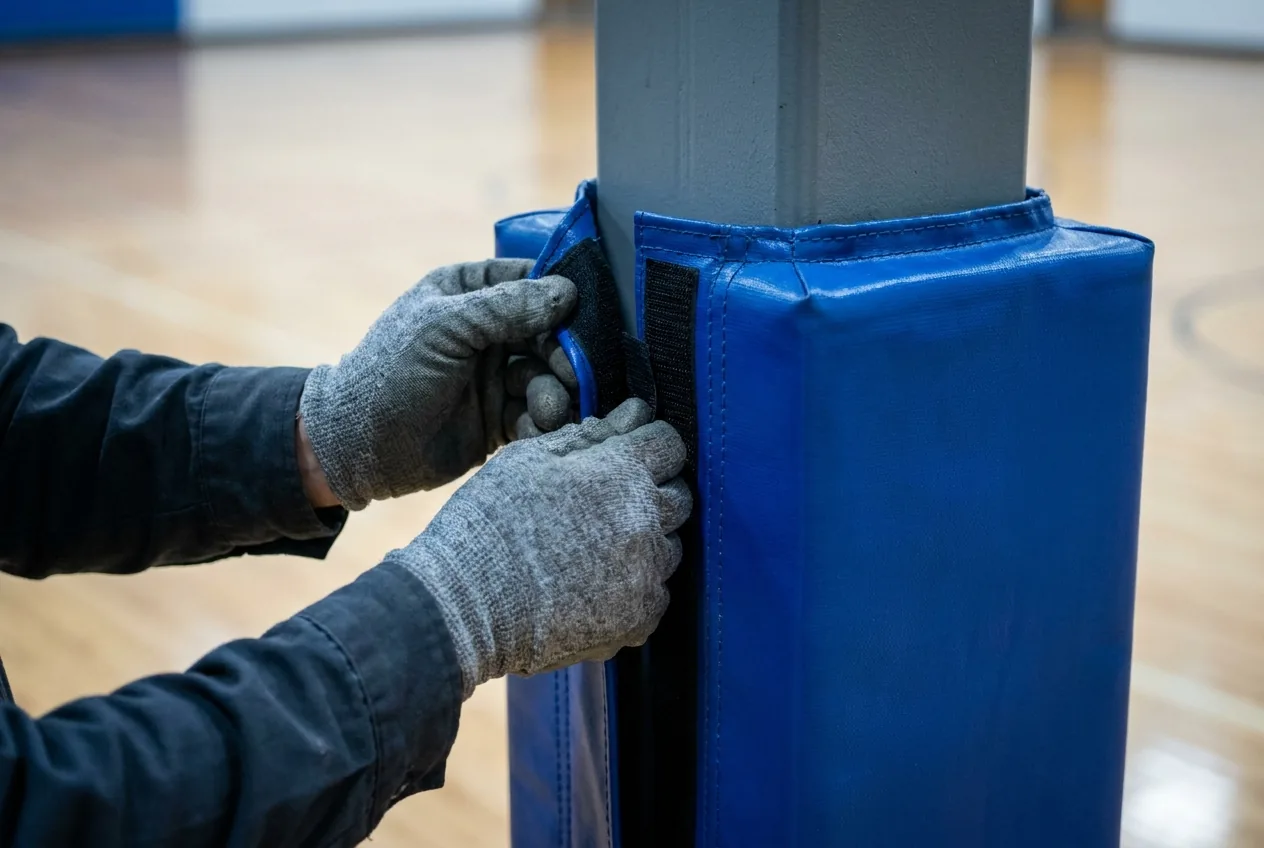
Dew points stay high most of the year here, rain arrives in heavy bursts, and an outdoor pad rarely gets a full day to dry through. Mildew shows up on the vinyl face first, almost always along the bottom edge and anywhere the pad sits flush against a post with no airflow. The fix is boring and it works: hose the face down and wipe it a few times a season, and when you unwrap a pad for cleaning, let both the vinyl and the post dry before you close the hook and loop back up. Pads stored over the summer should sit on a rack in a dry room, not stacked flat on a slab that sweats.
For posts that live outside year round in this climate we quote the heavier vinyl rather than the indoor baseline, and the vinyl weight and foam construction breakdown explains what you gain at each step.
Storm season is the part out-of-state suppliers miss. From June 1 to November 30, any pad strapped to an outfield fence or a light pole is potential wind load and potential debris. Full-length hook and loop closure is what makes that manageable: two people can strip a ballfield in an afternoon, get the pads inside, and put them back up the following week. If a pad does end up sitting in floodwater, pull it, open it, and dry it standing on edge, because foam holds water long after the vinyl looks fine.
How Houston Districts and Facilities Actually Buy Padding
Most of the volume here is school district gym and field work, and the district calendar sets every deadline. Texas campuses restart in mid-August, so the practical install window is June through the first week of August, which is the same window custodial teams use for floor refinishing and contractors use for bond work. Booking in February or March for a July install is not early, it is normal. In-season deadlines follow the sports: volleyball drives gym padding questions in the late summer, basketball drives them in the fall, and backstop and fence padding gets replaced over the winter break.
Indoor gym specs usually trace back to NFHS language. NFHS asks for at least 3 feet, preferably 10 feet, of unobstructed space outside the boundary lines. A portable backstop base has to be padded to 7 feet on the court-side surface, and a 9 foot backboard support gets padded 2 feet back from the backboard face. Send us a photo of the sightline problem and the ceiling height and we will size to it.
Outside the districts we quote church fellowship halls, municipal park systems, club volleyball and basketball facilities, HOA amenity centers and private backyard courts. Post sizes across all of them vary more than people expect, so start with how to measure a post correctly and send us the numbers with your quote request.
- Independent school districts: gym poles, wall pads, portable backstop bases
- Municipal and county parks: backstops, foul poles, fence line padding
- Church multipurpose halls that need padding to come down between uses
- Club volleyball and basketball facilities running long tournament days
- HOA amenity centers and residential courts in the master planned communities
Lead Times, Artwork and What Install Day Looks Like
Stock pads generally ship in 2 to 3 business days, and we schedule the crew around that date. Custom printed pads run longer because the art has to be proofed and approved before anything goes to production, and the artwork and proof requirements for printed pads spell out exactly what to send. Give us your hard date, whether that is a season opener, a facility inspection or a ribbon cutting, and we build the schedule backward from it.
On install day the crew arrives with the pads, re-measures the posts against what was quoted before anything is opened, and mounts everything with the full-length hook and loop closure. Summer scheduling is real work here: outdoor jobs get pushed to mornings because heat index and afternoon storms both peak later, and gym work goes best between seasons when the floor is not booked. A typical single-gym pole and wall pad job is a half day once access is sorted.
Quotes go through 917-546-4625, toll free 877-466-7101, or sales@mybackyardsports.com. Padding carries a 1-Year Limited Warranty. Custom Pole Pads is a division of My Backyard Sports, LLC, with the office at 570 Piermont Rd, Ste 125, Closter, NJ 07624. Houston crews work out of the field, so a call or an email is the fastest way to start.
- FT75 pole pad for 4 in and 5 in square posts, from $254
- FT78 6x6 pole pad from $307, FT79 6x6 pad and gusset from $402
- FT80P 6x8 pad only from $291, FT80 6x8 pad and gusset from $436
- Foam-only wall pad from $152, plywood-backed wall pad from $172
- Custom printed pole pads from $373.99, decals from $119.99
Keep reading
Do you actually install in Houston, or just ship the pads?
We install. Our own crews cover the Houston metro, including Katy, Sugar Land, The Woodlands, Conroe and Pearland, and we quote the install as part of the job rather than handing you a box. If your site sits outside that driving radius, you can order the same padding and have your maintenance staff mount it, since the hook and loop closure does not need special tools.
How far ahead should a Houston district book a summer install?
February or March for a July install is the realistic window. June through the first week of August is when every campus in the metro is doing floor refinishing, bond work and equipment swaps at once, and gym access is the bottleneck, not production. Tell us your first day of practice and we will work backward from it.
Should outdoor pads come down before a named storm?
Yes. From June 1 to November 30, anything mounted on a fence line, foul pole or light pole is wind load and potential debris, and the full-length hook and loop closure exists partly so two people can strip a field in an afternoon. If a pad has been sitting in floodwater, open it and dry it on edge, because the foam holds water long after the vinyl surface looks dry.
Does your padding meet ASTM F2440?
We do not claim compliance with it. F2440 is an impact attenuation standard written for indoor wall padding, and the materials page explains what it measures and what the numbers mean. If your district's spec references it, send us the spec language and we will tell you plainly what we can and cannot document.
Start a quote
Send us the
measurements.
Tell us the post size or the wall run, the colors you need, and whether it lives indoors or out. You will get a written quote back with a real lead time on it.
- A written lead time on every quote
- Purchase orders and W9 on request
- A proof before anything is cut