Custom printing
Custom Printed Pole Pads With Your Logo
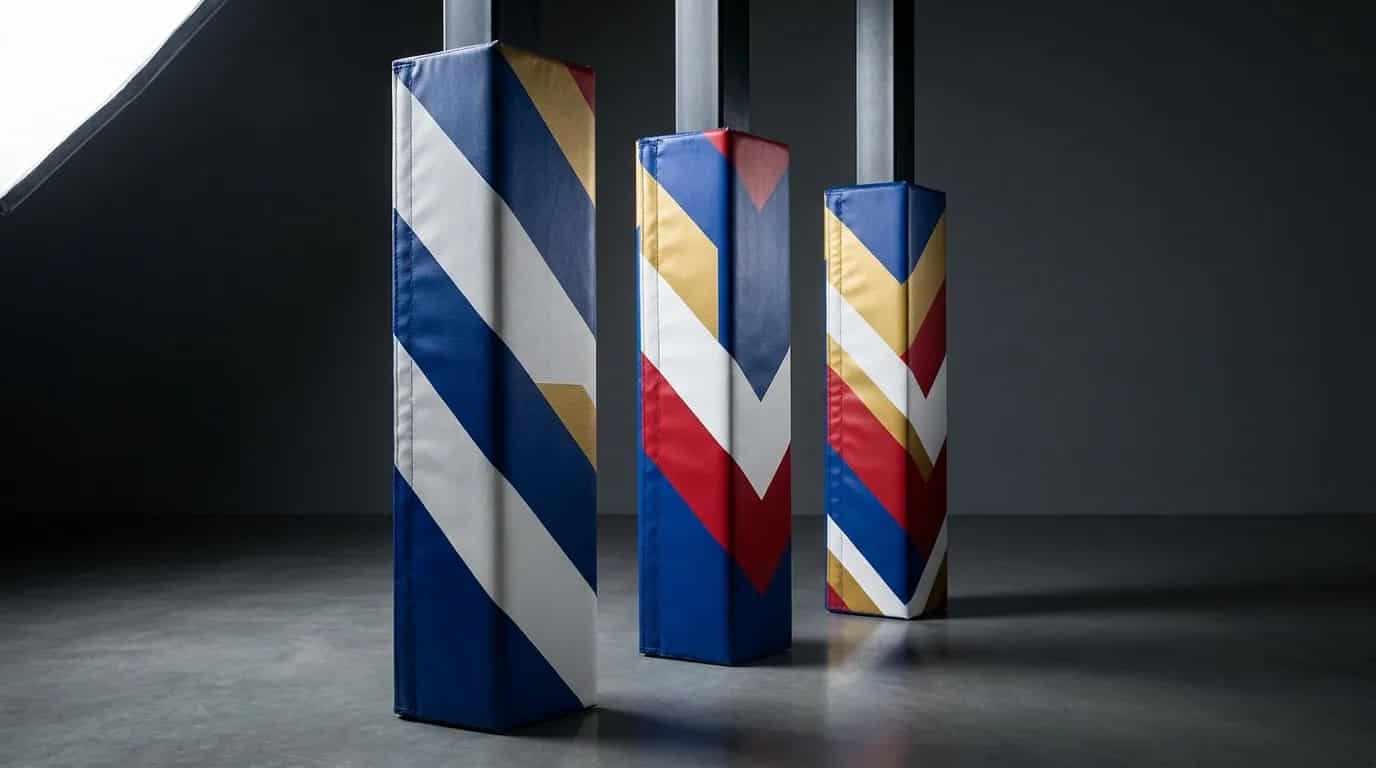
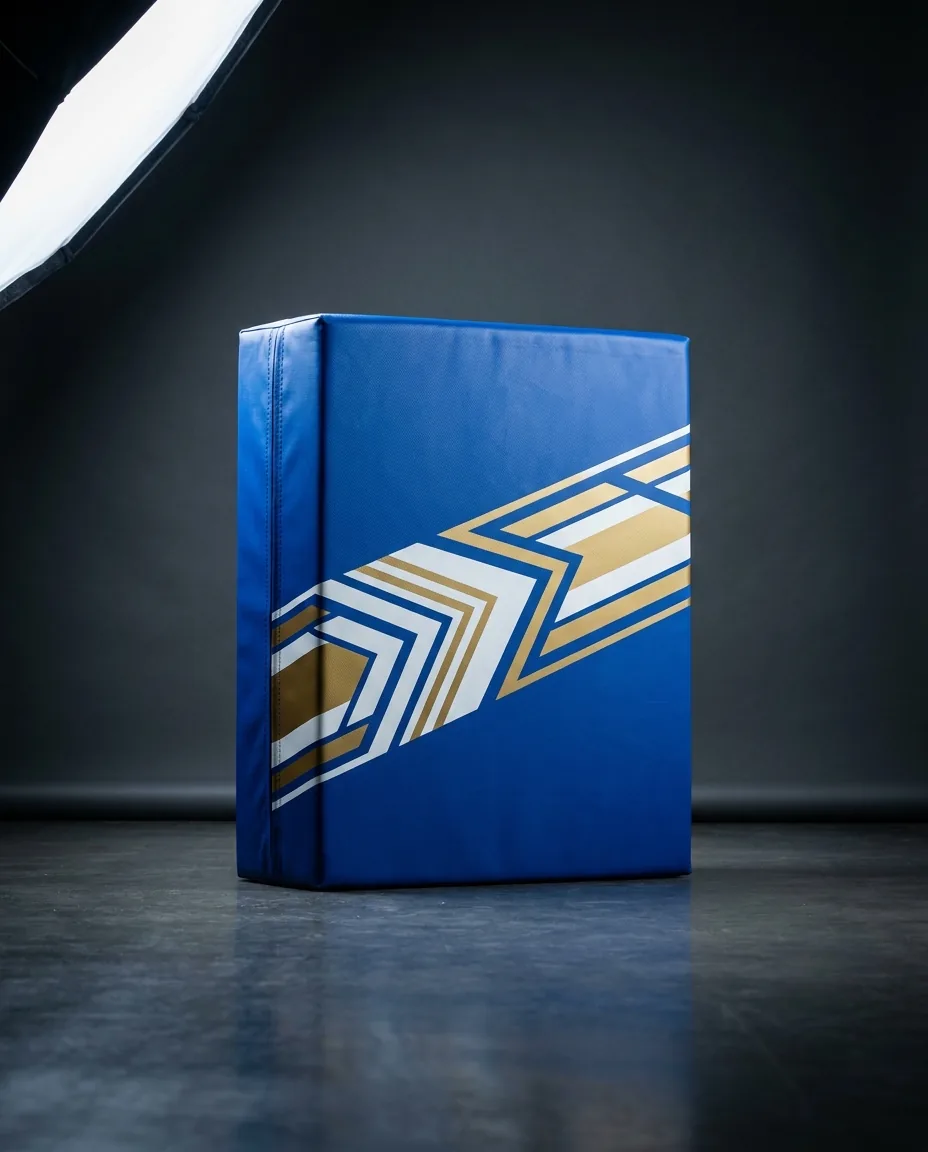
Custom printed pole pads put a logo, mascot or sponsor mark on the pad face itself. Decals do the same job on pads you already own, for less. This is the page that covers the print side of the order: what artwork we can use, where the logo actually lands on a pad that wraps a post, what the proof shows you, and how long approval really takes.
- Shipping
- All 48 contiguous states.
- Installation by our own crews
- New Jersey, New York, Connecticut, eastern Pennsylvania, plus the Austin and Houston markets in Texas. Coverage detail
Outside our installation markets we ship the product for installation by you or your contractor. Coverage states are New Jersey, New York, Connecticut, eastern Pennsylvania, the Austin and Houston metros in Texas.
Printed Pad or Decal: Which One You Actually Need
Two ways to get a logo on a pole pad. Print it into a new pad, from $373.99, or apply a decal to a pad you already own, from $119.99. If your existing pads are sound, with intact foam, unbroken vinyl and working hook and loop closures, the decal is the right call. Buy new printed pads when the padding itself is worn or when you are ordering pads anyway.
The tradeoff is edge durability. A printed graphic is part of the pad face. A decal sits on top of the finished pad, and its edges are the first thing a ball or a shoulder catches. Decals hold up well where contact is occasional, such as gym lobby columns, sponsor walls and baseline uprights that rarely get hit. On a post that takes contact at every practice, order the printed pad.
Run the math across the whole set rather than one pad, and think about how long the mark has to last. A school mascot does not change. A sponsor often does. If the logo on the pad is tied to a one year or two year sponsorship agreement, decals let you re-skin the same pads when the agreement turns over instead of buying the set again. If the mark is permanent, print it in.
- Custom printed pole pad from $373.99, with the graphic printed into the pad face.
- Pole pad decal and application from $119.99, applied to pads you already own.
- Decals suit lower contact locations and sponsors that rotate year to year.
- Printed pads suit high contact posts and pads already due for replacement.
- Mixed sets are fine: printed mascot pads on the court, decal pads in the lobby.
Artwork Files That Print Without a Redraw
Send vector art whenever you can: EPS, AI or PDF, with all fonts converted to outlines and strokes expanded. Vector scales from a small decal to a full pad face without softening, and outlined type removes any chance that a font we do not have gets substituted for something close but wrong. If vector is not available, send raster art at 300 dpi at the final printed size, not 300 dpi at business card size scaled up. A 300 dpi file enlarged ten times is a 30 dpi file.
Most schools have usable art somewhere. Check with your athletic department, your uniform supplier or your sign vendor before you pay a designer. A screenshot from a website, a JPG pulled out of a PDF or a logo lifted off social media will not hold up at pad size. If all you have is a low resolution file, say so up front. We can quote a redraw, and a redraw quoted at the start of the job costs less time than one discovered at the proof stage.
A few file habits prevent most of the back and forth. Embed linked images rather than referencing them, because a file that cannot find its own artwork opens as an empty box on our end. Flatten live effects like drop shadows and transparency, since those are where files shift between design software versions. Put one version of the mark in the file, not a sheet of options. Give color targets as PMS or CMYK values instead of a description, because our blue and your blue are rarely the same blue.
- Preferred: EPS, AI or PDF vector, fonts converted to outlines, strokes expanded.
- Acceptable: raster at 300 dpi measured at the final printed size on the pad.
- Embed linked images and flatten transparency and drop shadows before sending.
- Give color targets as PMS or CMYK values, not as a name or a screenshot.
- Tell us if the mark is licensed by a school, league or sponsor, and who signs off on its use.
Where the Logo Lands on a Wrapped Pad
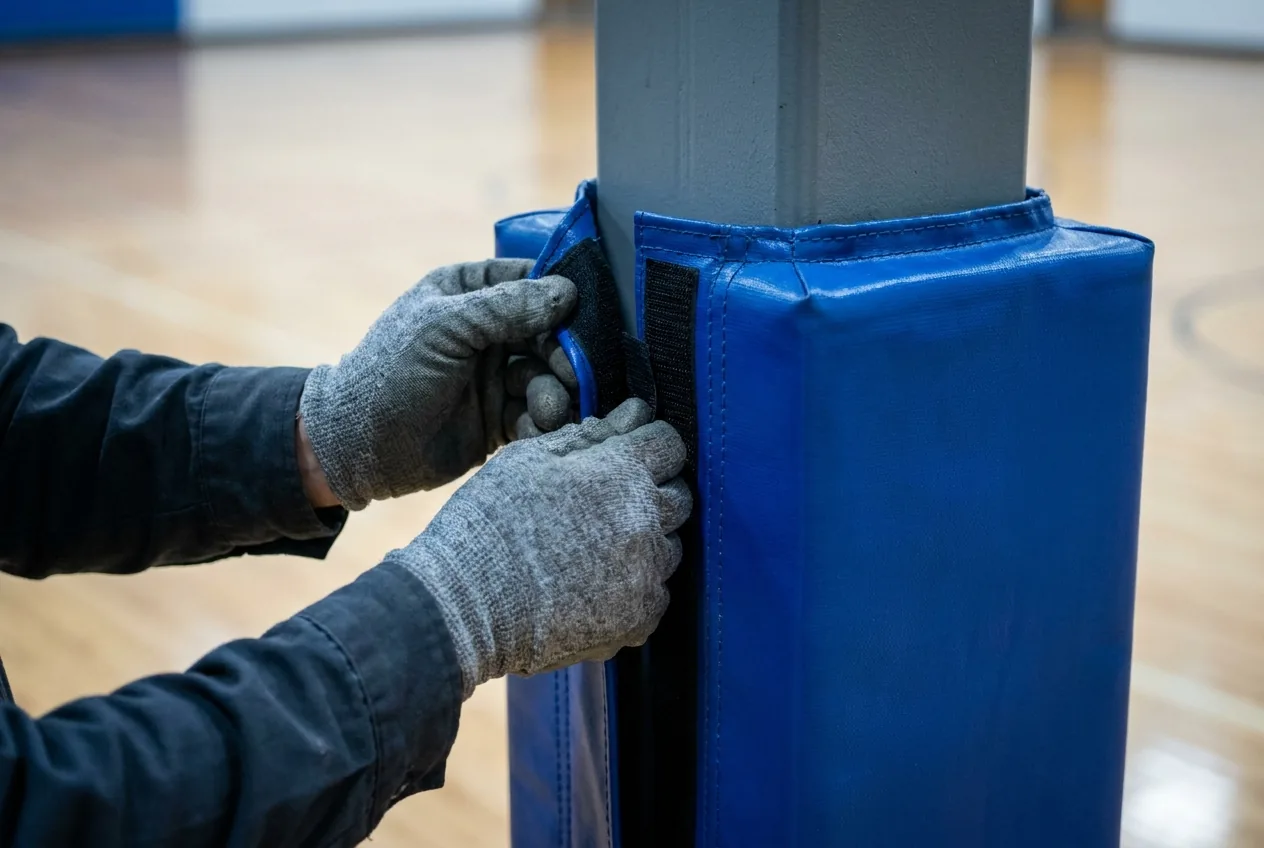
A pole pad is not a flat sign. It wraps the post, so your printable area is the width of one face, not the total width of the pad. Art centered on the flat pad blank can end up folded around a corner once the pad is closed on the post. Tell us which face the crowd and the cameras see, usually the one facing the court or the field, and we lay the art out for that face and keep it clear of the closure overlap. Pad width follows post size, so how to measure a post is the first step even on a print order, because it sets how much face you have to work with.
Pad graphics get read from across a gym, in gym light, usually while something else is happening. Bold marks win. A mascot head, a block letter wordmark, a flat two or three color logo and a sponsor name all read clearly. Heavy outlines survive. What struggles: fine gradients, thin hairlines, small body copy, drop shadows and photographic backgrounds. Text under roughly two inches tall is hard to read from the sideline and hard to hold cleanly on a vinyl face, so if your logo carries a small tagline we will usually suggest dropping the tagline and printing the mark larger.
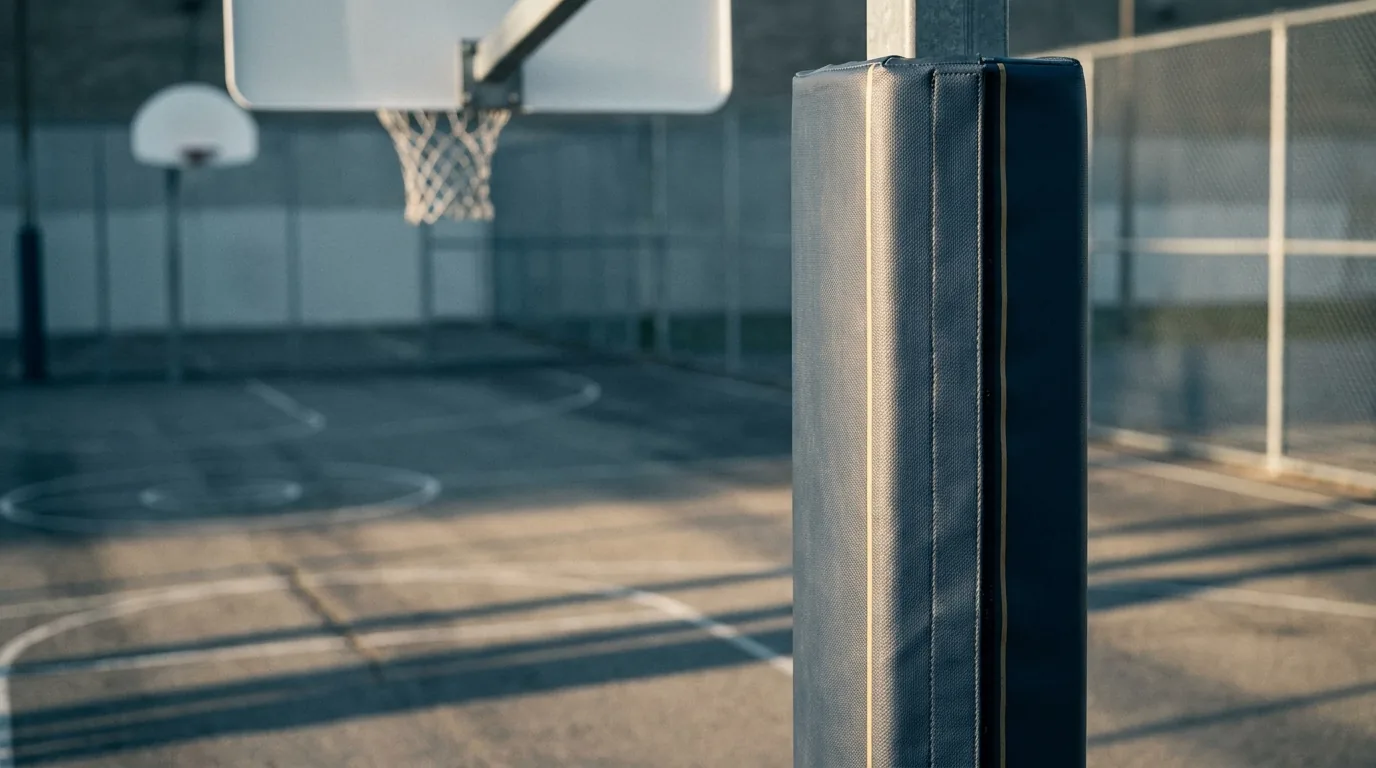
Contrast against the pad body matters more than exact color accuracy at that viewing distance. Light art on a dark pad and dark art on a light pad both read. Navy art on a black pad disappears, so pick the pad color with the art in mind from the stock vinyl color range. The graphic itself goes onto the coated vinyl outer, so how long the print survives contact is a function of the vinyl and foam construction underneath it rather than the ink.
- Name the face that faces the court so art is centered where people look.
- Art is kept off the closure overlap, where a wrapped pad doubles back on itself.
- Prints well: mascot heads, block wordmarks, flat two and three color logos, sponsor names.
- Prints poorly: gradients, hairlines, drop shadows, photo backgrounds, small taglines.
- Two sponsors on one pad usually means both read badly. One mark per face.
The Proof Process and Realistic Lead Times
Nothing prints until you approve a proof. Send artwork, the pad model, quantity, your post measurements and the pad color you want to sales@mybackyardsports.com. We lay the art out on the pad face, mark the printed size and the placement, and send it back for review. What comes back is a layout proof of size, position and color breakdown, not a photograph of the finished pad, so read it as a plan for the print rather than a preview of the vinyl.
Check four things and check them slowly: spelling of every word including the sponsor name, which version of the mark it is, the colors, and where the art sits on the face. Then approve in writing. Decide before you submit who at your organization is allowed to give that approval, because proofs stall most often when the person reviewing is not the person who can sign off. If a sponsor or a licensing office has to see it, build that round into your schedule.
Plan the calendar around the proof, not around production. Stock pads generally ship in 2 to 3 business days. Printed orders run longer because artwork has to be proofed and approved first, and every revision round restarts that clock. Schools that send art in June for an August install almost never have a problem. Schools that send art the week of a tournament usually do. Printed pads carry the same 1-Year Limited Warranty as our stock pads.
- Send artwork, pad model, quantity, post size and pad color to sales@mybackyardsports.com or call 917-546-4625.
- The proof shows printed size, placement on the face and the color breakdown before production.
- Check spelling, mark version, color and placement, then approve in writing.
- Every revision round restarts the production clock, so name your approver in advance.
- Order printed pads well ahead of a season opener, a tournament or a facility dedication.
How much do custom printed pole pads cost?
Custom printed pole pads start at $373.99 per pad. A pole pad decal with application starts at $119.99, which is the better buy when your existing pads are still structurally sound. Final pricing depends on pad model, post size, quantity and how many colors your artwork uses.
What artwork format do you need for a pole pad with logo?
Vector is best: EPS, AI or PDF with fonts converted to outlines and strokes expanded. Raster art works if it is 300 dpi at the final printed size, not 300 dpi at thumbnail size scaled up. Embed any linked images and flatten drop shadows and transparency before sending. If you are not sure what you have, send it and we will tell you whether it prints cleanly or needs a redraw.
Can you print a logo on pole pads I already own?
Yes, with a custom pole pad decal from $119.99 including application. This is the practical route for a mid-season sponsor change or a rebrand where the padding itself is still in good shape. Decal edges take more wear than printed graphics, so we suggest decals for lower contact locations.
How long does the proof and print process take?
Stock pads generally ship in 2 to 3 business days. Printed orders add proofing time, and the schedule depends on how quickly artwork is submitted and how quickly the proof comes back approved. Every revision round restarts production, so decide who signs off before you send art. Contact us with your install date and we will tell you what is realistic.
Start a quote
Send us the
measurements.
Tell us the post size or the wall run, the colors you need, and whether it lives indoors or out. You will get a written quote back with a real lead time on it.
- A written lead time on every quote
- Purchase orders and W9 on request
- A proof before anything is cut